Glass · Mirror · Acrylic
Free Glass Cutting Optimizer and Cut Calculator
This glass cutting optimizer plans how to cut your panes from full glass sheets with as little waste as possible. Enter the pieces you need and the sheets you can buy, press Calculate, and get a layout drawn to scale with the order of the score lines. Every cut runs straight across the piece, the way glass is scored and snapped. It runs in your browser, and your first 5 calculations need no account. The example above is a set of window and door panes: replace it with your own sizes.
Try it above ↑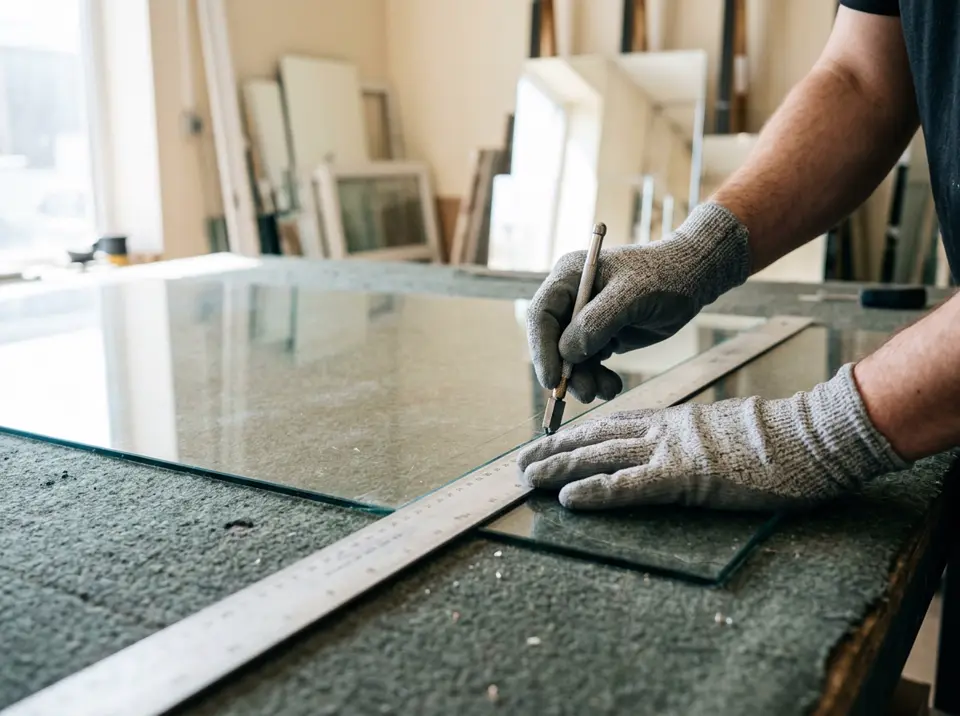
How to plan your glass cuts
- Enter your panes. Type the length, width and quantity of each piece in the Panels table. Use the final size of each pane and a label such as “window” or “mirror” so it is easy to find on the diagram.
- Enter your glass sheets. Put the sheet size in Stock sheets, for example 3210 × 2250 mm. Add other sizes if your supplier stocks several, or leftover pieces from earlier jobs.
- Set a trim allowance. Glass is scored, not sawn, so there is almost no material loss. Enter a few millimeters in the cut thickness option if you want a safety gap between pieces for the score and for grinding the edges.
- Calculate and score. The optimizer draws each sheet and numbers the cuts in order. Choose “Easiest to cut” to get long straight cuts that are simple to score and break.
Why this works for glass
Straight cuts only
Layouts use guillotine cuts: every cut goes all the way across the piece being cut. That is how glass is scored and snapped by hand or on a cutting table.
Less waste
The optimizer tries many arrangements and keeps the one that uses the least glass, leaving one large usable offcut instead of scattered slivers.
Trim allowance
Set a gap between pieces for the score line and for edge grinding, so the finished panes keep their size.
Rotation allowed
Plain glass has no grain, so panes can be turned to fit better. Lock a pane only if it has a pattern or a coating that must keep its direction.
Several sheet sizes
Add each sheet size and quantity you have, including offcuts, and the optimizer chooses what to use.
Export
Save the list as CSV, export a PNG of a sheet or print the plan to take to the cutting table.
Common glass sheet sizes
Stock sizes and thicknesses differ by supplier and country, so check what your glass merchant holds before you plan.
| Sheet | Millimeters | Inches |
|---|---|---|
| Float glass, standard plate | 3210 × 2250 | 126.4 × 88.6 |
| Float glass, jumbo plate | 3210 × 6000 | 126.4 × 236.2 |
| Smaller stock sheet | 2440 × 1830 | 96 × 72 |
| Common thicknesses | 3, 4, 5, 6, 8, 10, 12 mm | 1/8 to 1/2 |
Tips for cutting glass with less waste
- Cut tempered and laminated glass to size first. Tempered glass cannot be cut after tempering, so order it at its final size. Use the optimizer for annealed (float) glass you will score yourself or have cut to size.
- Score once, with steady pressure. One clean score line breaks more cleanly than a second pass over the same line.
- Leave room at the edges. The edges of a factory sheet can be uneven or chipped. If a layout is very tight, enter sheets a few millimeters smaller.
- Plan the long cuts first. Break the sheet into large strips, then cut the strips into panes. Large pieces are easier and safer to handle.
- Wear protection. Use cut-resistant gloves and eye protection, and sand or grind sharp edges after cutting.
Frequently asked questions
How do I calculate how much glass I need?
Enter all your panes and one sheet size, then press Calculate. The Global statistics panel shows how many sheets the layout uses and how much glass is wasted.
Is there a kerf when cutting glass?
Glass is scored and snapped, so almost no material is removed. Most people set the cut thickness to 0, or to a small value of 2 to 3 mm as an allowance for the score and for grinding the edges.
Can I rotate the panes?
Yes. Plain glass has no grain, so the optimizer may rotate panes to fit better. If a pane has a pattern, a coating or a visible direction, turn on grain direction and lock it.
Can I use it for mirrors and tabletops?
Yes. It works with any rectangular glass or mirror. Enter the size of each piece and the size of the sheet in the same unit.
Can I cut tempered glass with this plan?
Tempered glass is made to its final size, so it must be cut before tempering. Use the plan to work out the sizes to order or to cut annealed glass before it goes to the tempering oven.
Is the glass cutting optimizer free?
Yes. You can calculate without an account, and a free account gives you more calculations each day. Pro and Lifetime plans remove the daily limit.
More cutting calculators
The same optimizer, with an example and advice for each material.
Any sheet material
Cut list optimizer
The full tool for any sheet material: panels, stock sheets, kerf, grain, materials and edge banding.
Open calculator →
 Plywood
 cut calculator
Plan cuts on 4 × 8 ft and 1220 × 2440 mm plywood sheets with the fewest sheets and a simple rip-then-crosscut order.
Open calculator →
 MDF · Melamine · Chipboard
MDF & melamine cut calculator
Cut MDF, melamine and chipboard boards for cabinets and wardrobes, with edge banding totals.
Open calculator →